Brass is a good base for gold plated jewelry when the design needs cast or stamped detail, because it forms easily and is usually finished by electroplating. Stainless steel is another common base, and it usually gets its gold color from PVD coating. The two metals are shaped in different ways, plated in different ways and suit different kinds of pieces. At MAAS Jewelry a new brass design starts at 50 pieces per style. Electroplating and PVD coating are both available.
Brass and stainless steel as a base, compared
The base metal largely decides how a piece is formed and which plating process it gets.
| Brass | Stainless steel | |
|---|---|---|
| What it is | An alloy of copper and zinc | An alloy of iron with chromium |
| How it is shaped | Cast or stamped; takes fine detail | Cast, stamped, machined or cut; harder to form |
| How the gold color is applied | Usually electroplating | Usually PVD coating |
| Surface before plating | Polished or textured first; plating copies the surface | Polished or textured first |
| Typical pieces | Pendants with relief, textured earrings, medallions | Chains, huggies, plain rings |
How brass is shaped
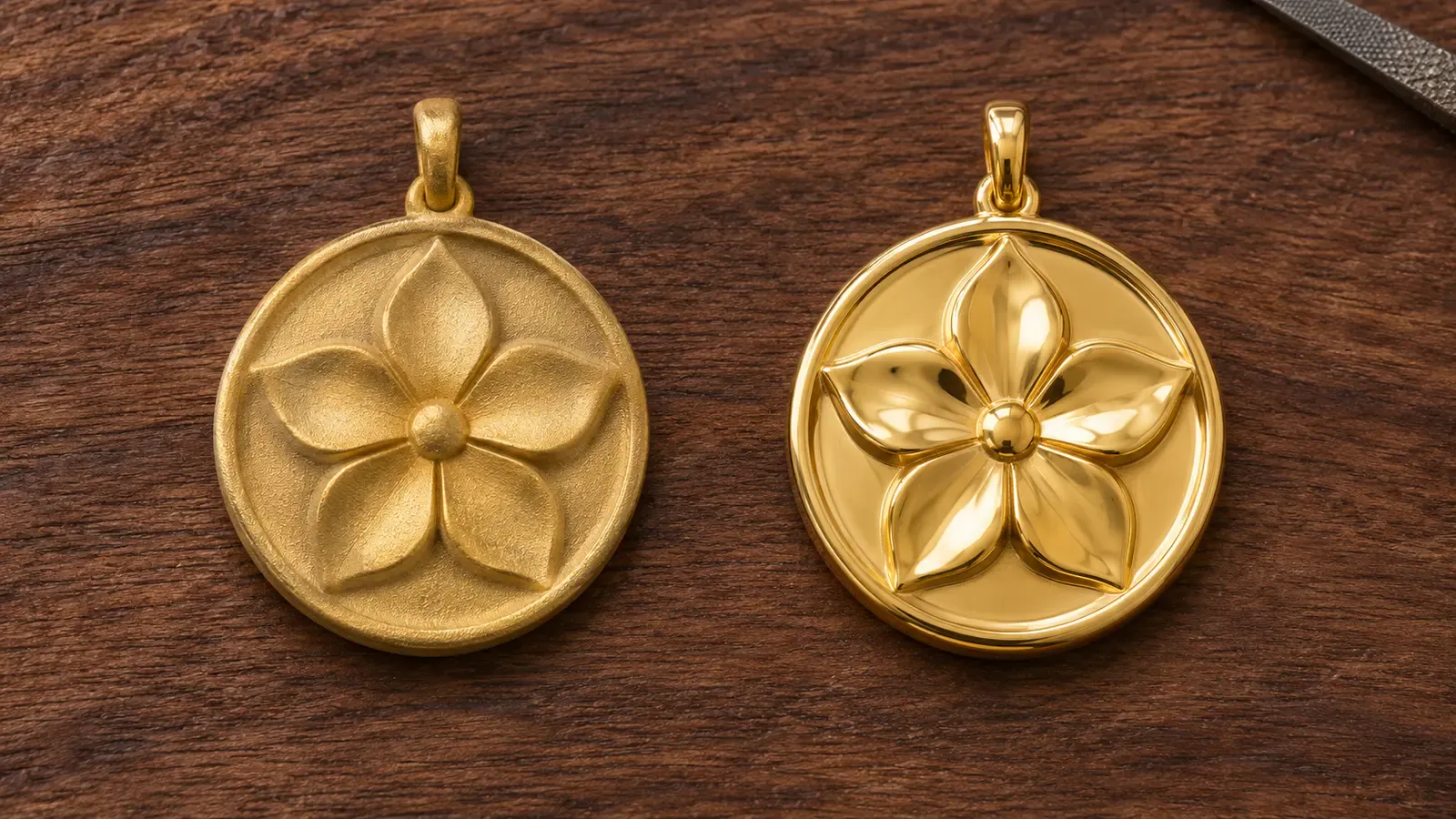
Brass is a soft metal to work. It fills a mold well in casting, and a stamping die presses a clean pattern into brass sheet. That is why brass is a usual choice for a design with relief, a textured surface or a sculpted edge.
Two processes cover most brass pieces:
Casting suits three-dimensional shapes such as pendants and charms. See jewelry casting.
Stamping suits flat or shallow parts made in volume, such as tags and thin pendants. See jewelry stamping.
A new brass design usually needs a mold or a die before the first sample.
How brass gets its gold color
Brass is usually finished by electroplating. The piece is cleaned and polished, then an electric current deposits the plating from a solution onto the surface. The layer is thin and follows the surface closely: a scratch or a casting mark under the plating is still visible afterward. Polishing before plating decides how smooth and bright the finished piece looks.
Put the plating spec in the quote request next to the metal: the color, the thickness in microns and how the thickness is checked. We check plating thickness on sample pieces with a thickness gauge during in-process inspection. Plating colors by material are on PVD and gold plating.
Does brass tarnish?
Bare brass tarnishes. The copper in it reacts with air, and the surface slowly turns darker and duller. Brass in jewelry is usually plated, and the surface the customer sees is the plating, with the brass underneath.
How stainless steel differs
Stainless steel is harder than brass, so it takes more work to form fine relief in it. Its gold color usually comes from PVD coating, a process in which the piece is coated inside a vacuum chamber. The two processes are compared in PVD vs gold plating.
Steel pieces are often simple forms made in volume: chains, huggies and plain bands. A design that depends on a detailed cast surface is usually easier to make in brass. Zinc alloy and 925 silver are covered with these two metals in stainless steel vs brass vs 925 silver.
Which designs suit brass
Start from the shape of the piece. These are the usual fits, not rules.
Relief, pattern or texture on the surface: brass.
A sculpted, three-dimensional pendant or charm: brass.
A plain chain, hoop or band: stainless steel.
A collection that mixes both: name the base metal and the plating process for each style.
Brass and stainless steel can sit in the same collection.
What to put in the quote request
The design file or a photo, with the size of the piece.
The base metal you have in mind, or a note that you want a recommendation.
The plating color.
The plating thickness you expect, in microns, and a request for how it is checked.
The quantity per style.
Approve the color on a physical sample before bulk production. Bulk production starts only after you approve the sample.
Brass at MAAS Jewelry
The brass range is on brass jewelry, and OEM covers designs of your own.