Gold plated is a surface layer of gold, gold filled is a gold layer bonded on and measured by weight, and vermeil is gold over sterling silver. Gold plated is a layer of gold or gold alloy deposited on the surface of the metal underneath, usually by electroplating. Gold filled is a layer of gold alloy bonded mechanically to the metal underneath and measured by weight: at least 1/20 of the metal weight in the US guides' examples. Vermeil is sterling silver under a thicker layer of gold.
These definitions follow the US FTC Jewelry Guides (16 CFR 23.3 and 23.4), and none of the three terms is a color name.
Gold plated, gold filled and vermeil compared
The table follows the examples in the FTC Jewelry Guides, which apply to jewelry sold in the United States.
| Term | Metal underneath | How the gold is attached | Gold level in the guides' examples |
|---|---|---|---|
| Gold plated by electroplating (gold electroplate) | Not fixed by the guides | Electroplated onto the surface | Gold or a gold alloy of at least 10 karat, at least 0.175 microns thick, measured as fine gold (16 CFR 23.3, checked 2026-11-24) |
| Gold filled | Not fixed by the guides | Bonded mechanically, by soldering, brazing or welding | A gold alloy of at least 10 karat that makes up at least 1/20 of the metal weight |
| Rolled gold plate, gold overlay or gold plated by bonding | Not fixed by the guides | Bonded mechanically | A gold alloy of at least 10 karat that makes up at least 1/40 of the metal weight |
| Vermeil | Sterling silver | Plated or coated onto the silver | Gold or a gold alloy of at least 10 karat, at least 2.5 microns thick, measured as fine gold (16 CFR 23.4, checked 2026-11-24) |
What "gold plated" means
Gold plated describes a surface layer of gold or gold alloy over another metal. The guides give two examples of the term. One is electroplating: gold or a gold alloy of at least 10 karat is deposited on all significant surfaces, at least 0.175 microns thick when measured as fine gold. The other is a mechanically bonded layer that makes up at least 1/40 of the metal weight (16 CFR 23.3, checked 2026-11-24).
Thickness in the guides is counted as fine gold, so the karat of the plating changes the figure. The guides' own example: one micron of 12 karat gold is equivalent to half a micron of 24 karat gold.
The term also carries the karat. In the guides' examples, "gold plated" and "gold electroplate" are immediately preceded by the karat fineness of the plating, as in "12 Karat Gold Electroplate". An electroplating that reaches 2.5 microns of fine gold can be called heavy gold electroplate (16 CFR 23.3, checked 2026-11-24).
The guides ask for "reasonable durability" from the gold layer under all three terms: every area of the layer is thick enough to give the coverage a reasonable consumer would expect from it.
What "gold filled" means
Gold filled is made differently from plated jewelry. A layer of gold alloy is bonded to the metal underneath by soldering, brazing, welding or another mechanical process. The gold layer is measured by weight: in the guides' example it is a gold alloy of at least 10 karat that makes up at least 1/20 of the metal weight of the article. The karat of the alloy is stated before the term.
A bonded layer of at least 1/40 of the metal weight can be called rolled gold plate or gold overlay, with the karat stated before the term.
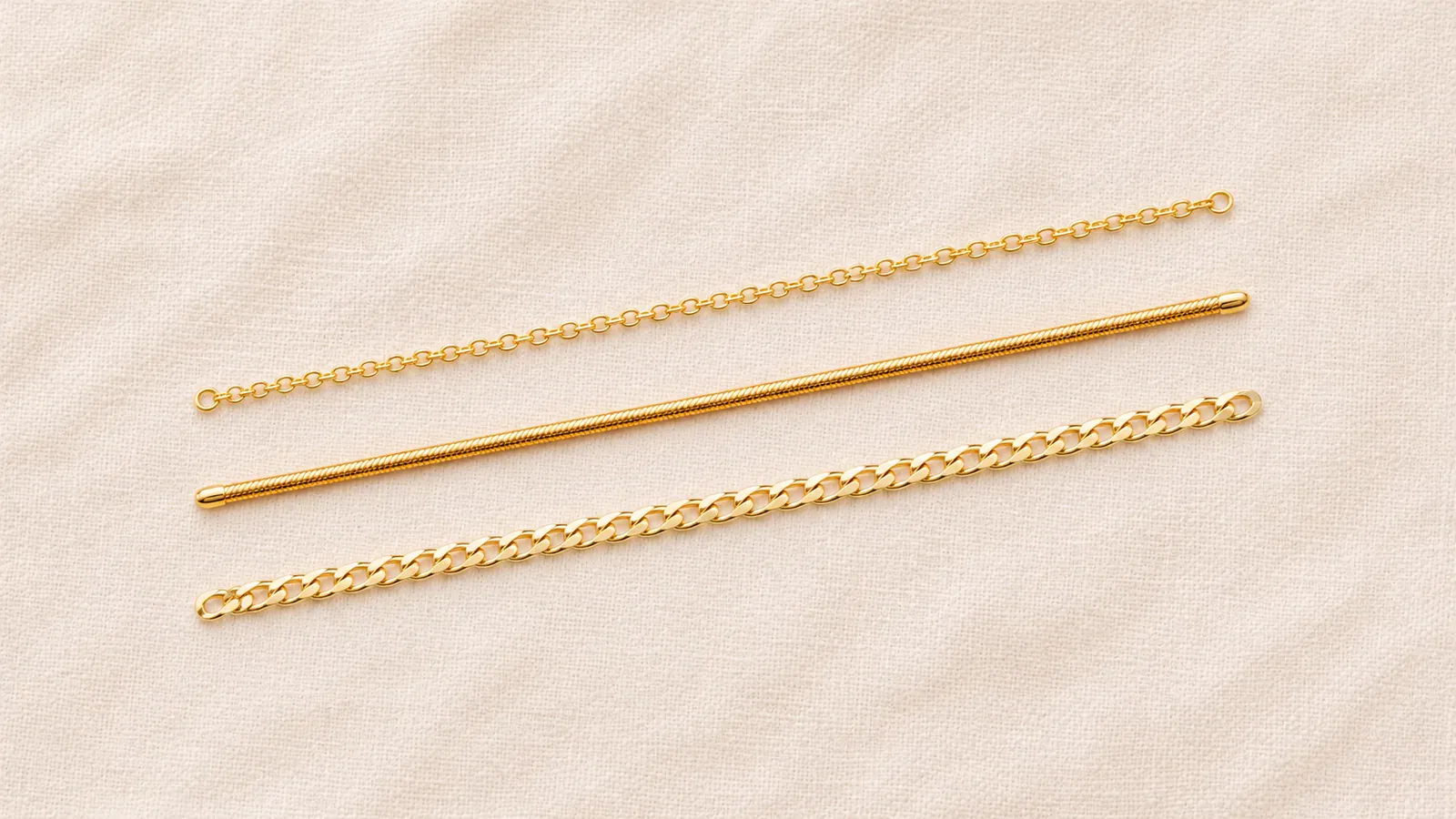
Gold filled material usually reaches a jewelry workshop as wire, sheet, chain and findings, so it suits designs that can be made from those forms.
What "vermeil" means
Vermeil is the only one of the three terms that fixes the metal underneath. In the guides it is sterling silver coated or plated on all significant surfaces with gold, or a gold alloy of at least 10 karat, at least 2.5 microns thick when measured as fine gold (16 CFR 23.4, checked 2026-11-24). A gold layer over brass or stainless steel does not fit the guides' description of vermeil.
The guides add one point. Where the silver is first covered with a base metal such as nickel and the gold is plated over that, the guides call the word "vermeil" deceptive unless the base-metal layer is disclosed.
Where PVD gold fits
PVD is a coating process and not one of these three terms. PVD vs Gold Plating explains how PVD and electroplating differ and which base metals suit each.
What to ask a supplier about a gold finish
Five answers help you work out which term a finish can carry in the market you sell in.
Metal underneath: sterling silver, brass, stainless steel or another metal.
Process: electroplating, PVD coating or a bonded gold-filled material.
Layer: what the surface layer is made of, and its karat where it is gold.
Thickness: the plating thickness in microns and how it is measured.
Market: where you will sell, because the FTC Jewelry Guides cover the United States and other markets have their own rules.
Gold plating terms FAQ
Is gold filled the same as gold plated?
No. Gold filled is a layer of gold alloy bonded mechanically to the metal underneath and measured by weight, at least 1/20 of the metal weight in the US guides' examples. Gold electroplate is a layer deposited on the surface, and its level in the guides is a thickness.
Can vermeil have a brass or stainless steel base?
No. In the US guides vermeil has a sterling silver base, so gold over brass or stainless steel does not fit that description.
Do these definitions apply outside the United States?
The FTC Jewelry Guides apply to jewelry marketed in the United States. Other markets set their own rules for these terms, so check the rules of the country you sell in.
Gold finishes at MAAS Jewelry
Electroplating and PVD coating are both available. The process and the plating option for each style are stated on the quote. The surface finishes page shows the finishes that go under or over the color.
Source: US Federal Trade Commission, Guides for the Jewelry, Precious Metals, and Pewter Industries, 16 CFR 23.3 and 16 CFR 23.4, as published on ecfr.gov, checked 2026-11-24.